
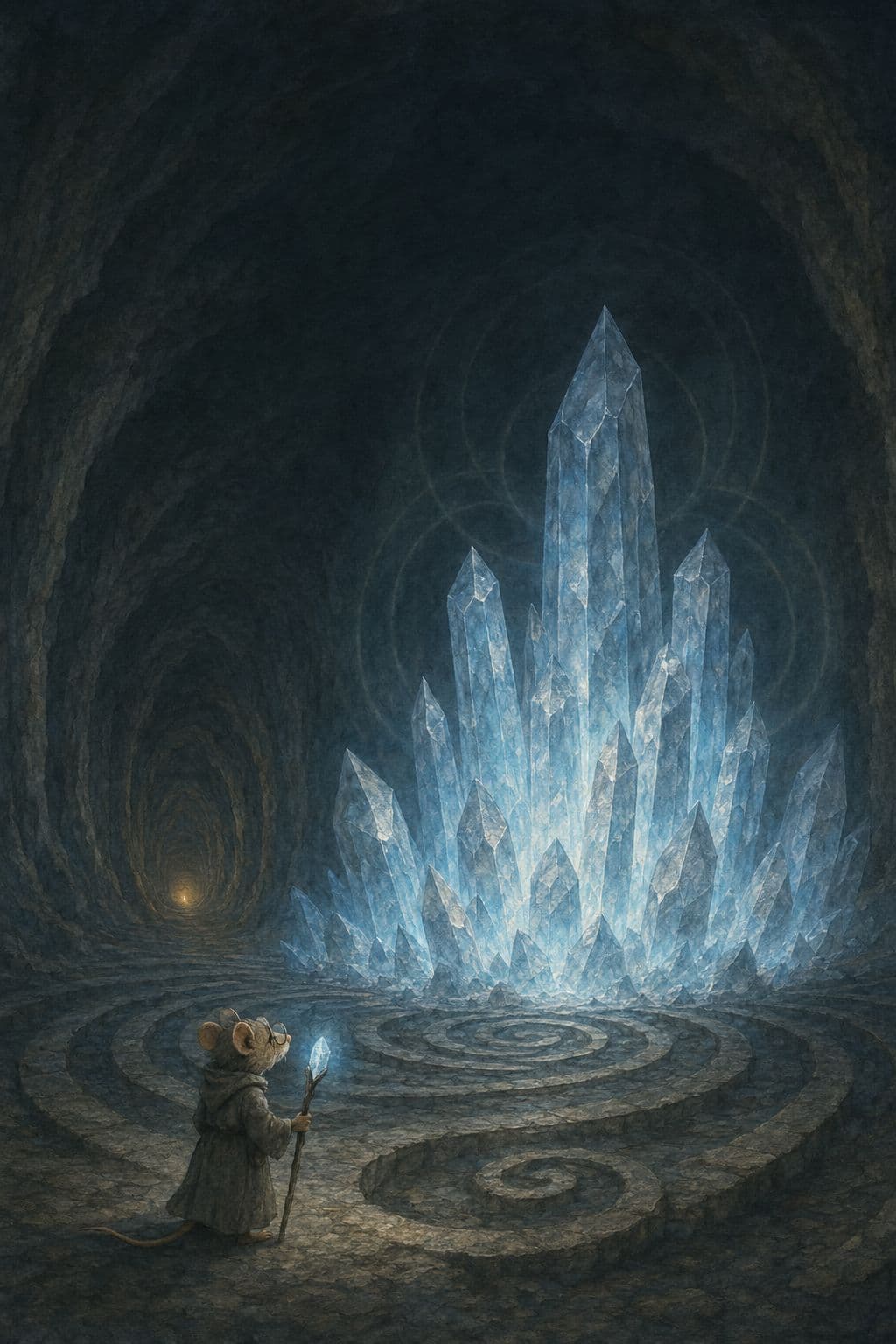
Read the opening
I.
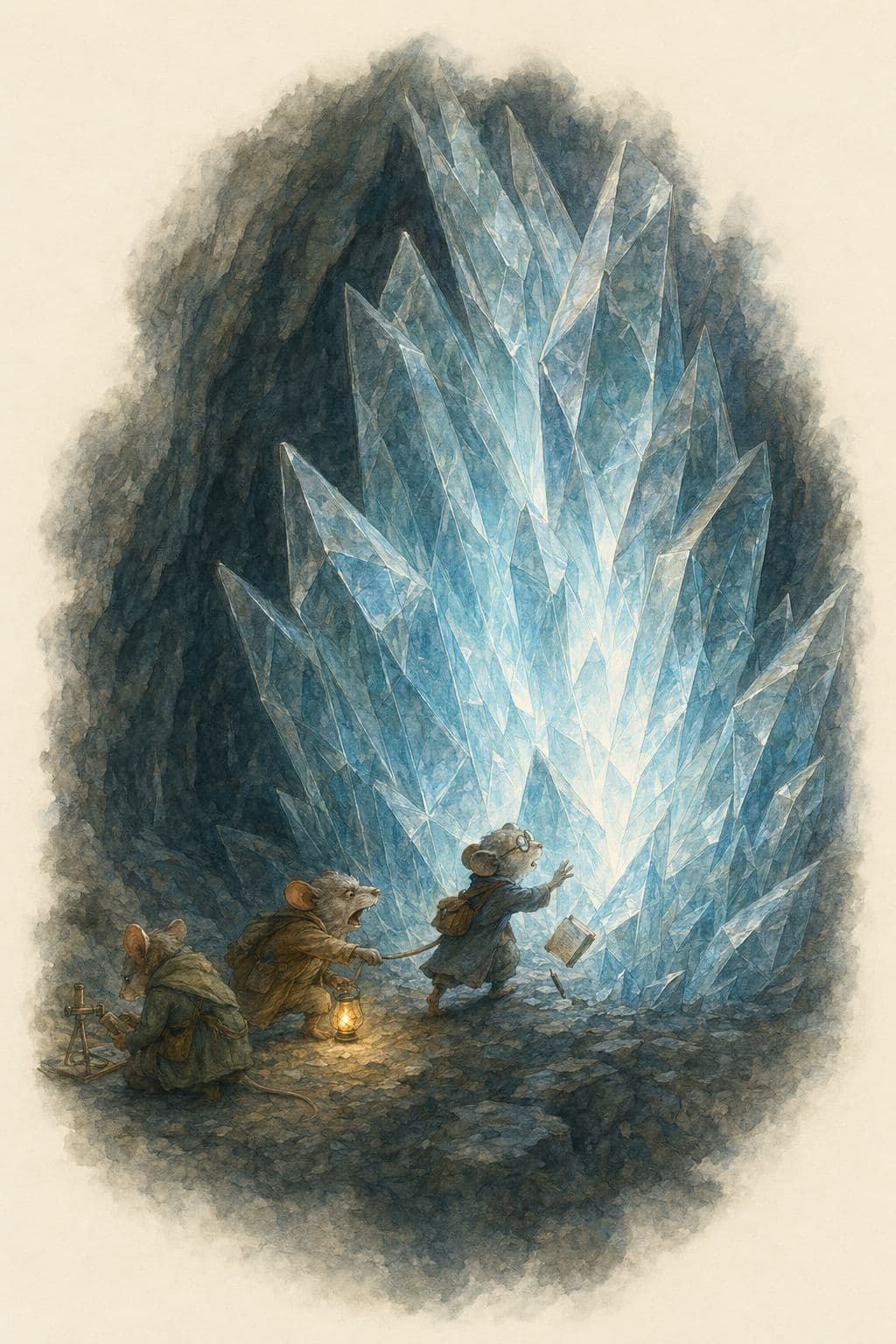
The Crystal Archive smelled of beeswax, old paper, and crystal dust. Crystal dust has a smell, whatever the senior conservators claim. It is faint and mineral, a little like rain on warm stone, and Ember had loved it since the first morning he was allowed down the stairs, age six, holding his mother’s paw and promising not to touch anything, a promise that lasted until she looked away.
He was small, even for a mouse. His spectacles sat crooked on his nose because one ear was set higher than the other, and after years of bending the wire he had given the crookedness up as permanent, like weather. He wore the grey wool robe of an archive scribe, ink-stained at the cuffs, and in its pockets he kept quartz fragments, folded notes, and the stub of a charcoal pencil that he sharpened with his teeth whenever he forgot his knife, which was most days. The taste of charcoal was, for Ember, the taste of work going well.
The Archive occupied the three lowest floors of the Mouse Quarter in the Lumenhall. Vaulted stone. Oak and ironwood shelves running floor to ceiling, packed with scrolls, bound codices, and loose sheets of bark-paper mapping the crystal veins beneath Hope’s Edge the way other maps charted its rivers and roads. The columns were carved in the old script, which nobody could read anymore except the mice, and among the mice only those who had sat for years in the cold rooms learning to feel the shapes of words older than the kingdoms. Crystal lanterns hung from iron brackets along every aisle and burned without flame; the light was coaxed out of the mineral by a resonance the mice had kept up for generations, a frequency applied to stone, closer to music than to fire. The stones themselves were mined crystal, and they wore out carrying it; the resonance endured, but the mineral was spent, which was why the carts kept coming up from the deep seams. Walking beneath the lanterns Ember could feel them humming, a tuning fork pressed to the inside of his skull. Most mice found the sensation unpleasant. He found it steadying, and always had.
There was also, that particular autumn, a war on. The Archive’s enemies were damp, silverfish, and a small brown beetle with a taste for binding paste, and the beetle was winning. Ember had spent the whole morning re-shelving the casualties of the beetle campaign, which is the only reason he was in the eastern quadrant map room at all, and why he was still there at closing bell, standing over reading table three (the one with the stain shaped like a boot, origin unknown, older than anyone living) with four third-age survey maps weighted open in front of him and his heart going like a drum.
“You’re going to wear a trench in the floor,” Rosemary said from the end of the aisle.
“I’m not pacing. I’m thinking.”
“You think very loudly.”
Rosemary was a Lead Cataloguer, one of four, and the youngest by a decade. She was large for a mouse, or properly sized, depending who you asked; next to her Ember looked like a comma next to a capital letter. She came from the grain rooms. Her whole family still worked there, and her sister Marigold liked to say, loudly, at every festival, that the Archive was a strange place to waste a strong back. Rosemary had clawed her way down into the stacks anyway, apprenticeship by apprenticeship, and she kept a private ledger in her head of every favor owed and every favor spent, because a mouse from the grain rooms does not get to be careless with either. She wanted a Council seat someday. She had never said so out loud to anyone, including herself.
She crossed to the table and looked at what he had.
“Eastern quadrant,” she said. “Third age. You requested these on, what, Tuesday?”
“Monday. Look at this.” He put his claw down on a notation in the lower margin of the oldest map, where the survey lines ran off the edge of the known galleries and into hatched blankness. Two words in the old script, small and deliberate.
Rosemary read them twice. “The Heart.”
“It’s on three of the four. Same position, same script convention, three different survey teams, decades apart. And it isn’t on anything else. Not the current maps. Nothing from the second age either, and I checked every reconstruction we hold, all nine of them. The notation exists in the third age and then it’s gone.” He was talking too fast and made himself stop.
“Lost in the Fracture, probably. Half the great records burned.”
“That’s what I told myself on Tuesday.” He slid the fourth sheet across, a vein diagram, the kind that mapped how resonance moved through stone. “But then, look. The vein patterns in the deep survey all bend. Every channel we’ve ever charted converges down and east, toward the same blank region those three maps bothered to label. Something down there is holding a concentration of resonance large enough to feed every lantern in the Lumenhall. Something that hums.”
Rosemary stood very still. She had spent eleven years in this archive, and she knew, the way you know a fact about your own body, that the resonance came from somewhere. It came up through the stone, and the mice channeled it, tuned it, made it safe. Where it began was a question the Archive had a thousand documents about and no answer to.
“You’re saying there’s a source.”
“I’m saying three dead surveyors thought so, and mapped it, and then somebody stopped copying their maps.” He took his spectacles off, rubbed the bridge of his nose, put them back crooked. “I wanted someone else to see it before I convinced myself it’s nothing. I’m good at that. Give me a week alone with a discovery and I’ll bury it myself.”
This was true, and it was the thing about Ember that Rosemary found most exasperating. Three years she’d worked with him, since he arrived as an apprentice with his terrible handwriting and his freakish memory for where things were. He could tell you which shelf held a document he’d touched once, four years ago, and which way the label faced. And he used all that gift the way a miser uses gold, hoarding, checking, never spending.
“The Council meets in six days,” she said. “I’m presenting the preservation proposal anyway. I could add an item.”
“You shouldn’t. If it goes badly it lands on you, not me. You’ve got standing to lose.”
Rosemary did the arithmetic in her private ledger, and it was not a short calculation. Standing was the only currency she had ever had, and she had been saving it for years, for a purpose she didn’t name. Spending it on another mouse’s blank spot on a dead survey map was, by any sensible account, a bad trade.
“I’ve got standing because I spend it on the right things,” she said, which was at least half a lie, and she knew it, and did it anyway. She took the pencil stub out of his paw, turned his notebook around, and wrote the agenda line herself, in handwriting three times the size of his.
He stared at her. Underneath the surprise she could see hope arriving in him slowly, like light coming up, the specific hope of a mouse who had braced for disappointment and now had to stand down.
“Don’t thank me yet,” she said. “Wait till Thorne’s finished with you.”
She left him to lock up. He didn’t sleep much that week.
That’s the end of Part I.
The full illustrated edition is coming to the Goblin Den list. Join, and you’ll hear first when the stories are out.
Join the Den