Read the opening
I.
Brock was born three hundred feet down, in a mining burrow called Deephollow, on a night when the wind over the Grey Mountains was strong enough to be heard even at that depth, a low mutter in the rock that the old badgers called the mountain talking in its sleep. His mother finished checking the ore tallies before she let anyone go for the midwife. That story got told at every naming-day supper for twenty years. Brock never laughed at it. His mother said that was the funniest part.
The family business was stone. His father, Edmond, could lay two knuckles against a tunnel wall, tap twice, and tell you whether the rock would hold for a season or a century. His mother, Edna, could smell iron ore through three feet of granite, a talent she refused to explain and got tired of demonstrating for visitors around the time Brock turned six. His great-great-grandmother had cut the first passage of the Deephollow seam with her own claws, back when the world above was at war over something nobody in the burrow could name anymore. Somebody probably could, up at the Lumenhall, in a ledger. Nobody from Deephollow had ever gone to check.
When Brock was eight, his father took him to a junction in the west workings and made him put his ear against the wall.
“What do you hear?”
Brock listened. “Nothing.”
“Tap it.”
Brock tapped it. The sound came back flat and close, like knocking on a full barrel.
“Again. Lower.”
He tapped lower, and this time there was a hollowness under the sound, a faint second voice.
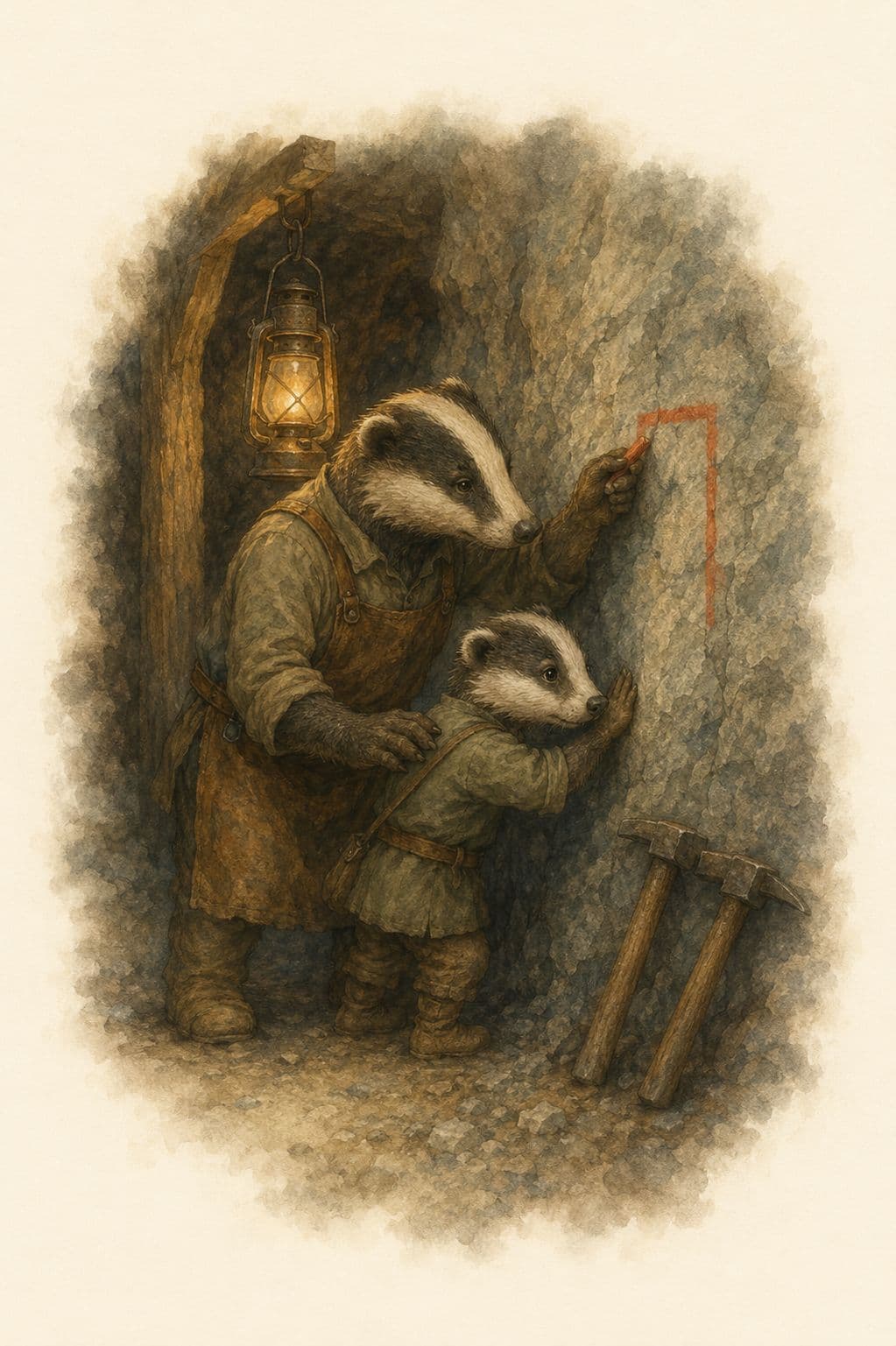
“There’s a fault behind that face,” Edmond said. “Runs down and east. In a year, two, it’ll want to open. So we don’t cut here.” He took the lump of red chalk from behind his ear and drew a mark on the wall, a circle with a line through it, the Deephollow sign for leave it be. Then, above the junction where the rock was sound, another mark: a plain upright stroke with a flat bar across the top, like a doorway. Holds.
“How do you know it holds?” Brock asked.
“Because I listened.” His father put the chalk back behind his ear. “The mountain always tells you. Most animals are too busy talking to hear it.”
That was more or less the whole of Brock’s education, repeated in a hundred small variations across thirty years of tunnel. Listen first. Mark what you learn. Don’t cut what you can’t hold.
He grew up big, even for a mining family. Broad across the shoulders at twelve, hauling double carts at fourteen, and quiet in a way that worried the neighbours until they got used to it. He wasn’t sullen. He answered questions. He just answered them with the number of words the question actually required, which was usually a small number, and his mother liked to say he’d been born with a fixed supply of words and was rationing them for a long life. Brock privately thought this was probably right and saw no reason to waste any confirming it.
Every night after shift, his father sat on the same stool by the tool wall and dressed the striking faces of his hammers with a grey whetstone the size of a bar of soap, worn saddle-shaped by two generations of hands. Not sharpening; a hammer has no edge. Dressing. Taking the burrs off the face so the blow lands true. The sound of it, stone on iron, slow and regular, was the sound Brock fell asleep to for nineteen years. His father said a tool you didn’t look after was a promise you didn’t mean to keep. He said that one a lot. It was, by Brock’s count, one of only four or five things Edmond ever said twice.
The Grey Mountains were old workings, cut with an engineer’s patience into rock the lowlands never touched. Deephollow mined ore and traded it down the Ashward Pass to the surface towns for grain and leather and, once or twice a year, a book nobody admitted to ordering. They asked nothing of the Lumenhall except to be left alone, and the Lumenhall, which kept a whole shelf of ledgers for places it left alone, obliged.
That’s the end of Part I.
The full illustrated edition is coming to the Goblin Den list. Join, and you’ll hear first when the stories are out.
Join the Den