
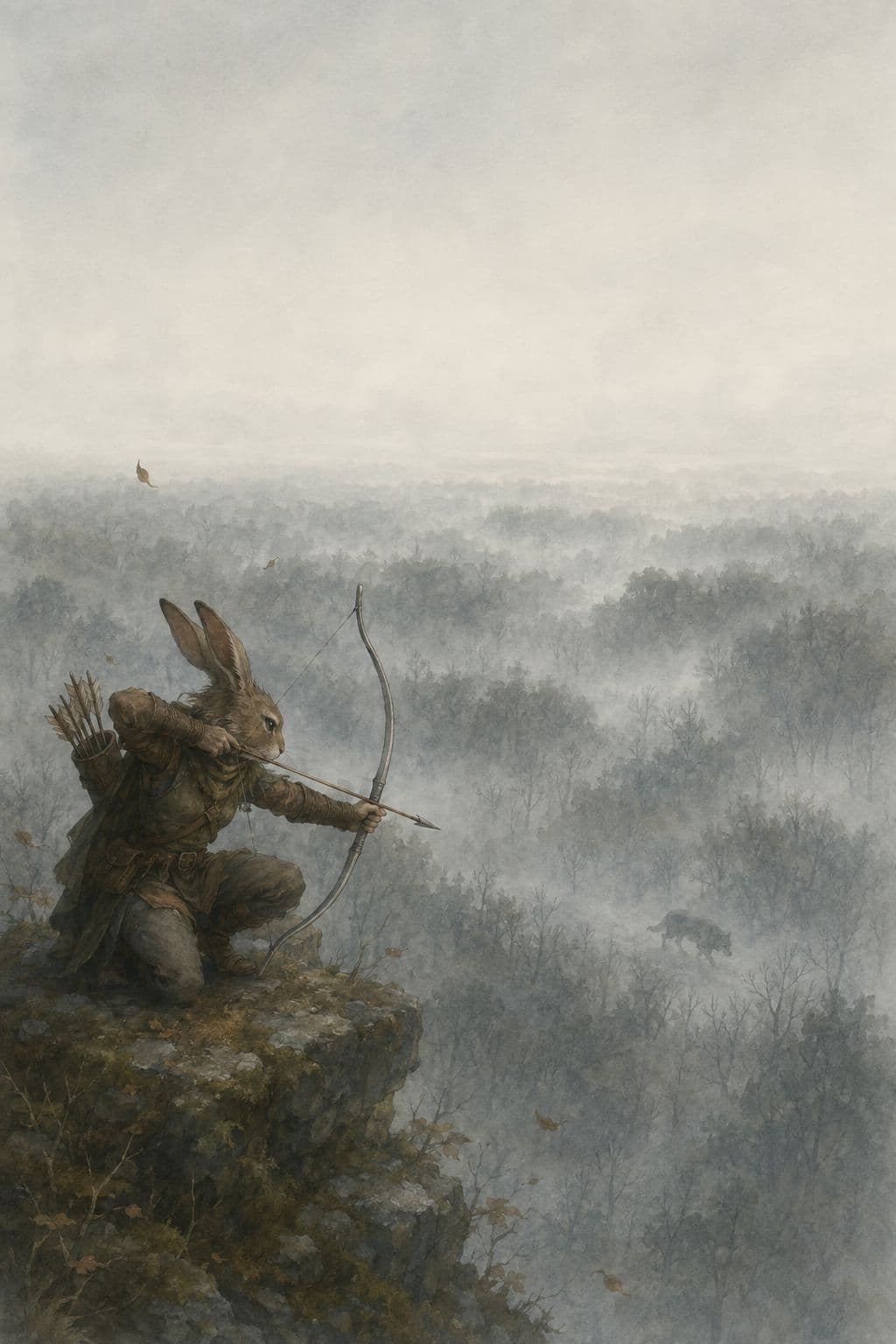
Read the opening
I.
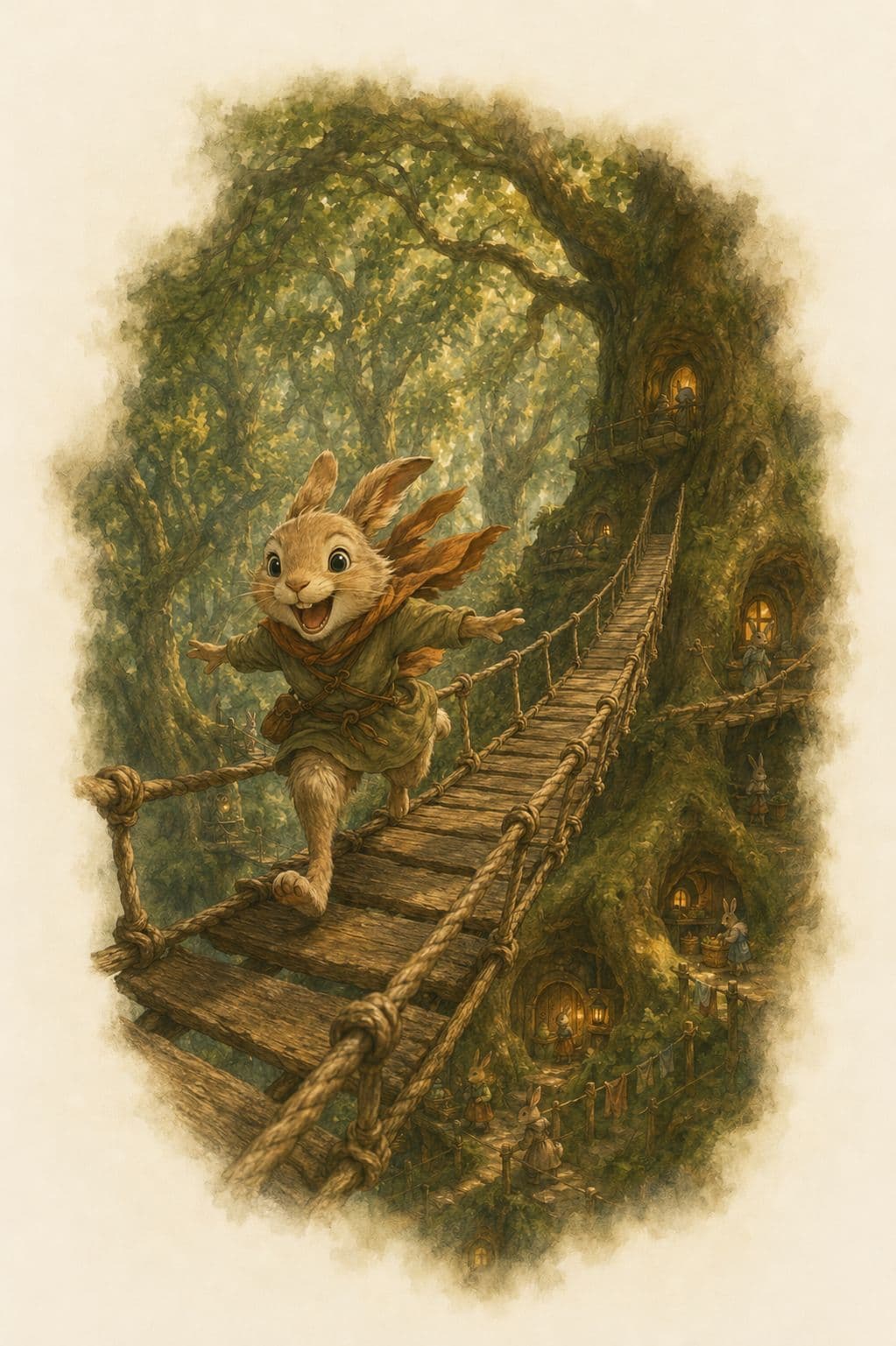
Before the silence, there was noise, and most of the noise was Pip.
This is the part the stories leave out. They tell you about the ranger of the Frontier woods, the rabbit who walks alone, the archer whose arrows find their mark with a patience that borders on cruelty. They make her sound like something the forest grew on its own, quiet and inevitable, a weapon shaped by solitude. The rabbits who actually knew her as a child laugh at that. Then they stop laughing, because most of what they are remembering is gone.
Pip was born in Briarhollow, a settlement of twenty families tucked into the eastern woods of the Frontier, where the trees stood so close that sunlight reached the ground only in scattered coins. It was not an underground warren. The founders had built into the forest instead of under it: homes in the root hollows of old oaks, rope bridges strung through the canopy, larders dug into the cool side of the hill. Briarhollow appeared on no map held at the Lumenhall, and this was not an oversight. The founders had paid a fox surveyor, three generations back, to leave a blank where the settlement stood. Rabbits are good at not being found. It is the oldest skill they have.
Her mother was called Tansy, and she kept the orchard, eleven apple trees on the south slope, and she had a habit that everyone in Briarhollow found harmless and slightly odd: she named things. All eleven trees had names. The oldest was Grandfather Sour, who gave small bitter apples that made the best keeping-cider, and the youngest was Button, who had never fruited and in Tansy’s opinion was simply shy. She named the well bucket. She named a particular fence post that kept coming loose. When Pip asked her why, somewhere around her sixth year, Tansy was up a ladder with her sleeves tied back and did not stop working to answer.
“You keep what you name,” she said. “That’s most of what remembering is.”
Pip’s father was called Sorrel, and he was one of Briarhollow’s three rangers, which in a hidden settlement mostly meant walking the boundary stones and making sure nothing from the wider Frontier wandered in with questions. He was practical and unsmiling and precise, and he did not understand his youngest daughter at all.
There were four children. Bram and Rowan, the brothers, worked a shallow crystal seam at the wood’s edge, a modest operation that earned modest coin and left their paws permanently grey to the wrist. Della, the sister, ran the trading post, kept the settlement’s only ledger, and licked her pencil before every entry, a habit she denied having. Twice a season, fox merchants came up the old drover’s track from the Frontier towns to trade grain and ironwork for herbs, mushrooms, and crystal dust, and on those days Della was the most important animal in Briarhollow and behaved accordingly.
And then there was Pip, who climbed.
It was not a phase. Her mother predicted for years that it would be a phase. By the time Pip could stand upright without toppling she was scaling the oaks that ringed the settlement, and by ten she ran the rope bridges at a flat sprint, and by thirteen she was making jumps between canopies that no other rabbit in Briarhollow would attempt, or watch. Old Burdock, the badger who kept bees at the settlement’s edge and loathed noise in all its forms, once told Sorrel that his daughter was going to come down out of a tree the fast way one morning and that he, Burdock, did not intend to be the one who found her. Sorrel thanked him and went back to splicing rope.
What nobody understood, because Pip never explained it, was that she was keeping an archive. She knew the shape of every tree within a mile of the boundary stones. She knew which branches flexed and which snapped, the exact length of the gap between the old oak and the hickory, the reach the maple demanded, the terrible height of the pine. She was mapping the forest the only way that mattered to her, with her body, and the map was more accurate than anything the Lumenhall’s surveyors ever drew.
Years later this archive would save her life, and other lives too. At the time it mostly got her shouted at.
She was loud. This should be said plainly, because everything that came after depends on it. Pip talked at meals, talked on the bridges, talked to Burdock’s bees, sang tunelessly while she climbed, and asked her father questions at a rate he privately compared to woodpecker damage. The quiet came later, and it did not come cheap.
That’s the end of Part I.
The full illustrated edition is coming to the Goblin Den list. Join, and you’ll hear first when the stories are out.
Join the Den